
Case study
A trilingual, fully static platform for Morocco's PHP community
- Client
- PHP Morocco
- Industry
- Tech community — non-profit
- Website
- phpmorocco.ma ↗
- Published
The Moroccan PHP community's platform: developer directory, events and resources — a national meeting point for the tech ecosystem.
Engagement details
Our role
- Platform design & development
- Visual identity & UX
- Community management
Tech stack
- Static site generation
- Cloudflare
The context
PHP Morocco brings together developers, companies and curious newcomers around the language that runs a large share of the web. The community organises conferences, meetups and workshops across several cities — Casablanca, Rabat, Marrakech, Tangier — and runs on volunteer effort.
A community like this has two needs that pull in opposite directions. It needs a credible public face: when a company considers sponsoring a conference, or a developer discovers the collective through an event announcement, the website is the first piece of evidence they weigh. And it needs a working tool: announce upcoming gatherings, archive past ones, publish articles, list job openings, present sponsorship tiers, collect newsletter sign-ups.
Two constraints shape everything else. First, language: the Moroccan audience reads Arabic, French and English, and technical vocabulary circulates in English — a single-language site excludes part of the very people it wants to gather. Second, the volunteer model: nobody is paid to administer the platform. A solution that demands a server to watch, monthly security patching or a recurring hosting budget ends up abandoned, however good it was on day one.
The solution
We designed and built the platform around a simple principle: anything that can be computed when the site is built should not be computed on every visit.
The site is fully pre-rendered and served from Cloudflare’s network. There is no database to back up, no application server to maintain, no dependency to patch under pressure. Only the forms — newsletter sign-up, contact — reach server-side code, in an isolated function that validates the input, filters bots with a honeypot field, and routes each message to the right inbox based on its subject.
Trilingual support is treated as an architectural fact rather than a translation layer bolted on afterwards. Every page exists in English, French and Arabic, generated from a single route definition; hreflang tags and canonical URLs declare those equivalences to search engines. Arabic switches the document to dir="rtl" and the layout follows, because the interface is built on logical CSS properties — start and end of a line rather than left and right — instead of margins that would need flipping one by one.
Content is typed at the source. Events, articles, job listings and sponsorship tiers are described by explicit structures: an event is a conference, a meetup or a workshop, with a city, a date and a registration status; a listing carries a company, a work arrangement and a salary range. The benefit is concrete — the build fails when data is inconsistent, instead of publishing a broken page.
That same structure feeds search visibility with no extra editorial work. Every event, article and listing exposes its data as JSON-LD in the vocabulary search engines expect, and each page’s social sharing image is generated automatically during the build — organisers never have to produce a graphic for an announcement to look right when it is shared.
The platform today
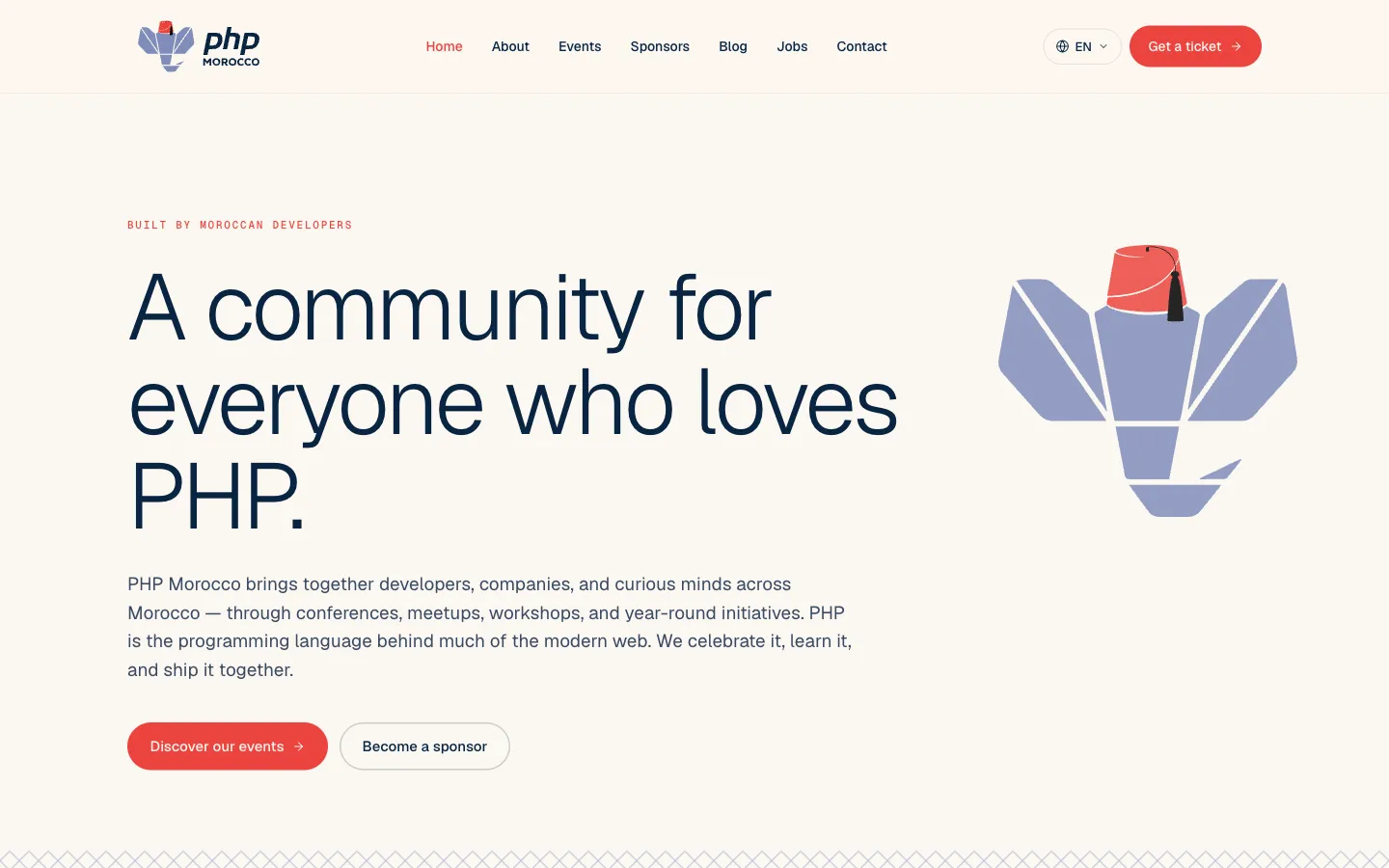
The site is live at phpmorocco.ma in all three languages, and serves as the community’s public entry point.
It carries the collective’s full range of activity: the calendar of upcoming gatherings, the archive of past editions — including the Technopark Casablanca meetups and the annual conferences — an editorial section, sponsorship tiers with their benefits spelled out, and a job board open free of charge to companies hiring PHP developers in Morocco.
Running costs stayed proportionate to a volunteer organisation: static hosting, no infrastructure to administer. Adding an event or a listing means describing a new entry in the site’s data; publication and sharing metadata follow on their own.